The tape
Every print, newest first, a row each. A row's colour is the taker's side, green bought, red sold, and its strength is how much the print mattered in its own market: the chatter barely tinted, the prints that matter bright. The same tape runs on the wall's rail, in Focus and on the tape page.
The product's own tape on the manual's synthetic market. Press a taker: the book is cut, and the print lands at the top of the tape in its colour.
A row
- Strength
- Barely tinted for an ordinary print, plainly coloured for a notable one, bright for a large one, fully saturated for the largest; its figures step up in weight with it, so the prints that mattered read first.
- Chevron
- A print that walked the book: ^ it bought up two levels or more, v it sold down; heavier past three.
- Price · size · notional
- The price the print reached, its size where there is room, and its notional ($ 323.4 K); on a tape of many markets, the market's mark and ticker first.
- Age
- In the clock's seconds: one second's prints share one age, said once, and every age on the tape turns together, once a second.
- A million and up
- A print of a million dollars or more is marked as it arrives: light runs once through its bar and writes its figure, then the bar keeps a hairline rim of light. Ten million and up carries a slow silk of light for its first minute and a block, the market's word for a print that size.
Two faces
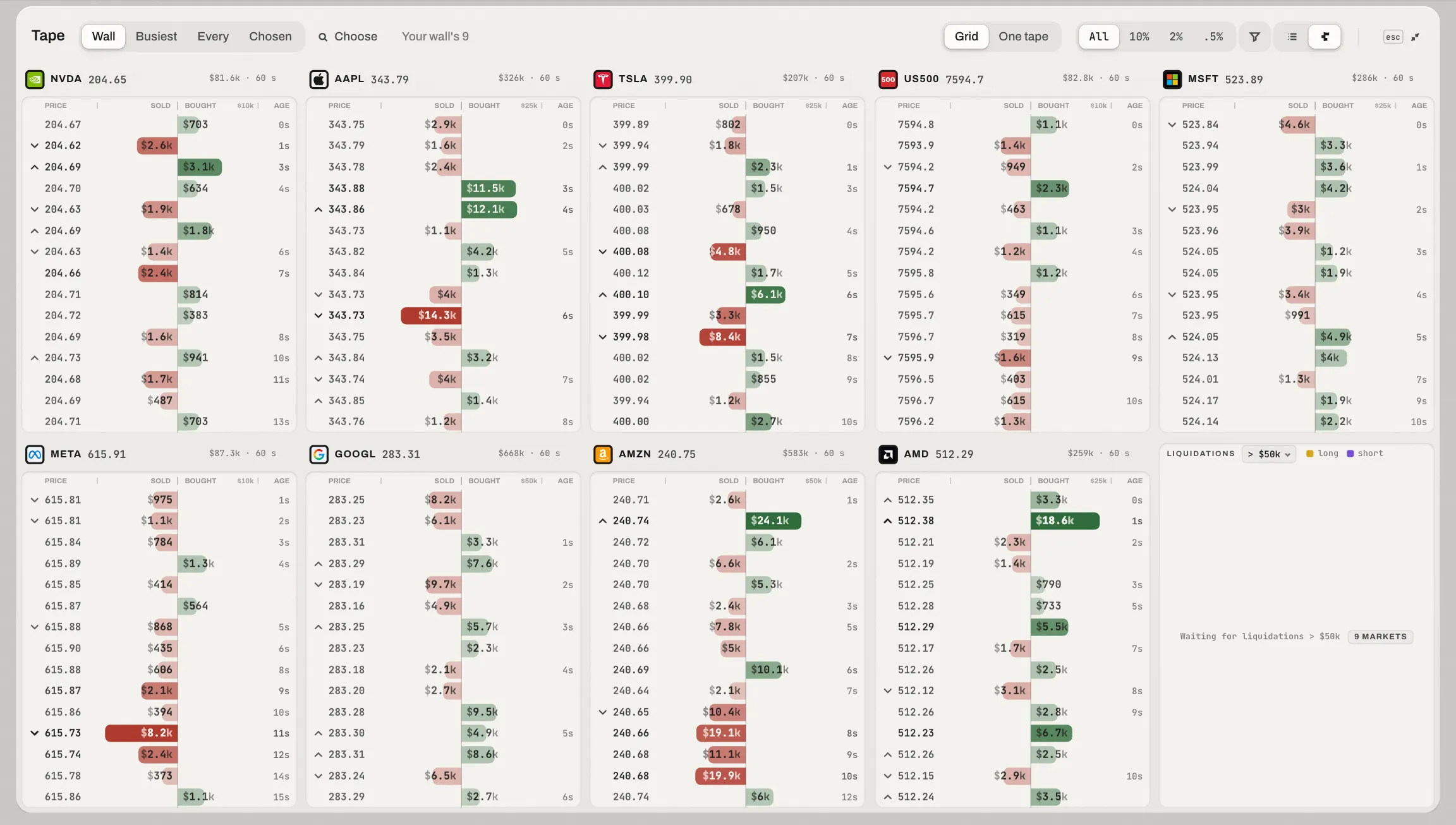
The tape can also be read as bars. A key beside the filter, in every tape's head, swaps the rows for a zero line: a print that bought is a bar to the right of it, one that sold is a bar to the left, and the bar's length is its notional. Forced prints keep their own colour. The face is kept by each place, so Focus can read bars while the wall's rail reads rows.
 12
The tape page on the sample data, a tape each, every print a bar from its zero line.
- The edge
- The lane's end is a round sum, said once in the head (
EDGE $50K · √), set so nearly every print fits and the largest few reach it. A print past the edge stops at it with a notch of light, so one block never flattens the rest. - The root scale
- Length follows the square root of the notional, so a small print is still a bar you can see beside a large one, and a large one is never ten times the screen.
- It moves slowly
- The edge rises at once when bigger prints arrive and falls only after a quiet half minute, so bars glide and never jump under your eye.
- What stays quiet
- The mark, the price and the age sit at the edges in quiet ink; every bar holds its notional at its root, against the zero line.
Liquidations
QFEX tags forced flow on its tape, and the tape says it as traders read it: a long liquidated (forced to sell) in yellow, a short liquidated (forced to buy) in violet, a skull where the chevron goes. They print in the rows, and the strip at the foot of every tape lists them over a floor of their own (> $50K to start; press it to change it).
On the wall: a tape of now
The wall's rail lists the markets on the wall's cards: a smaller layout than the wall, or the positions view, narrows it with them, and a market that leaves the cards takes its prints out of the tape. Its rows are the live prints of the last two minutes; the rest of the last ten waits under a band at their foot, last 10 min with how many, shut until you press it.
- Earlier rows
- Hatched, in quieter ink, each with its time in the terminal's zone where a live row has its age, and never arriving: the live prints past two minutes, what the record held when the page opened, a market added since, and what printed while the tab was hidden.
- Nothing older
- Nothing older than ten minutes is on the rail. A market's whole tape, with QFEX's older pages, is Focus's Trades pane.
- Nothing live
Nothing live right now · the last print here was 3m agowhen the wall has gone quiet; ten minutes with no liquidation says so too.
The filter
One filter on every tape. The minimum is a preset in each market's own terms: every print, or the top 10%, 2% or 0.5% of that market's prints, so one setting means the same on NVDA and on a thin book (on a tape of one market each preset says where it starts there now, ≈ $31K). Its key opens the whole filter, a small live picture over each setting: the minimum as a market's prints drawn as a curve — many small, a long tail of large — with the four cutoffs on it and the part that passes shaded, a dollar floor of your own a marker on it; the side as a bar, bought beside sold; forced prints as QFEX's two liquidation tags; and on a tape of many the markets. Every tape remembers its own.
- The rail's markets
- The wall's cards (out of the box); the cards and markets you add, up to sixteen, found by ticker or name; or every market QFEX prints (trades only, no book). When it is not the wall's, the rail's head says which in a pill (
wall + 2,every market), and a press opens the filter.
How much a print mattered
Each market keeps its own record of what printed, decaying with a twenty-minute half-life so it follows the session, and a print is read as its percentile there. The share of the displayed book it cleared and the levels it walked only lift a print already in the tail; they never make one on their own.
- Early read
- A young record (under forty prints) says so: its reading is blended with a floor set from the market's own minimum.
History is not news
A print that happened before its market joined a tape (the record's last minutes, a market newly added, a tab coming back) is seated silently in its time order. Only a print that happened after its market joined, and in the last moments, arrives: it slides in from the top and fades up to its own colour. While you read, new prints wait above, and a pill says how many.
A flood
At ten thousand prints a second every row would be under a second old, always arriving and never read. So a burst bigger than half a screen keeps a quarter of a screen of rows of its own (every forced print, every print of a million or more, then the heaviest in their market's terms) and says the rest in one row a side: 478 prints · $833 K · 219.01 → 219.08. Nothing is dropped: every print in the fold is still counted, so a filter turned afterwards says it exactly.
The tape page
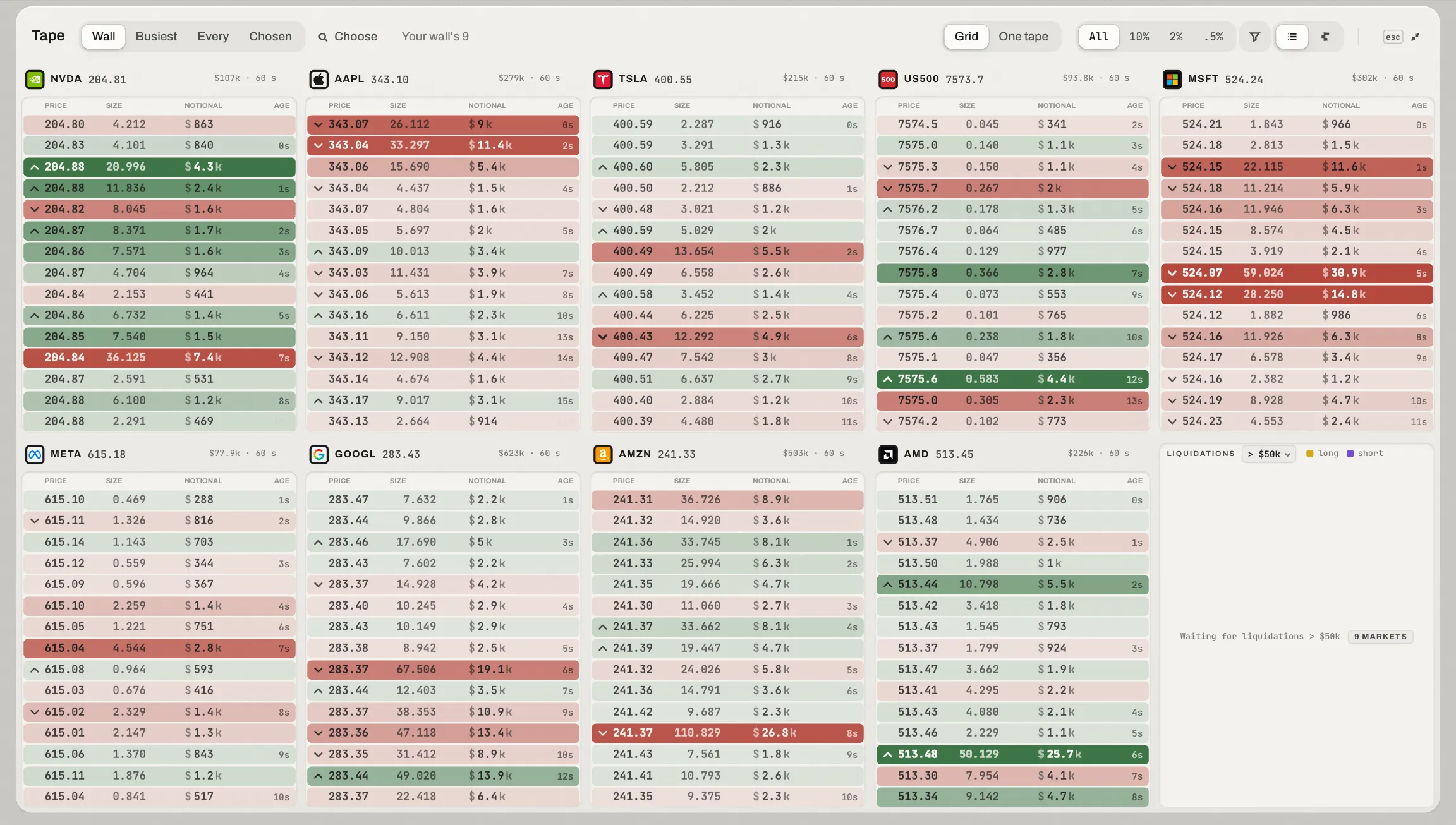
/tape is the wall's tape grown into a page: a tape for each market side by side, or every market's prints in four tapes by size. The rail's maximise opens the rail into it; esc, the way back at its top right, or the browser's Back closes it into the rail, its rows, scroll and filter where you left them.
 12
At 1440 × 900 on the sample data: the wall's markets, a tape each, and the liquidations.
Which markets: your wall's (its cards, and any you added to its tape), the busiest (the last fifteen minutes' notional where the venue's bars have said it, and the bar says which), or every market QFEX prints. Then the filter.
A tape for each market in as many columns as the screen holds at a readable width; a tile's head opens the market in Focus. The grid's last tile is the liquidations.
Every market, by size
Every deals every market's prints into four tapes side by side by what each cleared: under $1k, $1k – 10k, $10k – 50k and $50k and up. The chatter fills the first and moves fast; the last moves only when size trades, so a large print stays in view long after the small ones have scrolled past, whichever market printed it. A sweep still growing moves on to the next tape as it crosses a band's top. The filter reads all four, and the liquidations are one line across their foot until the first arrives.